
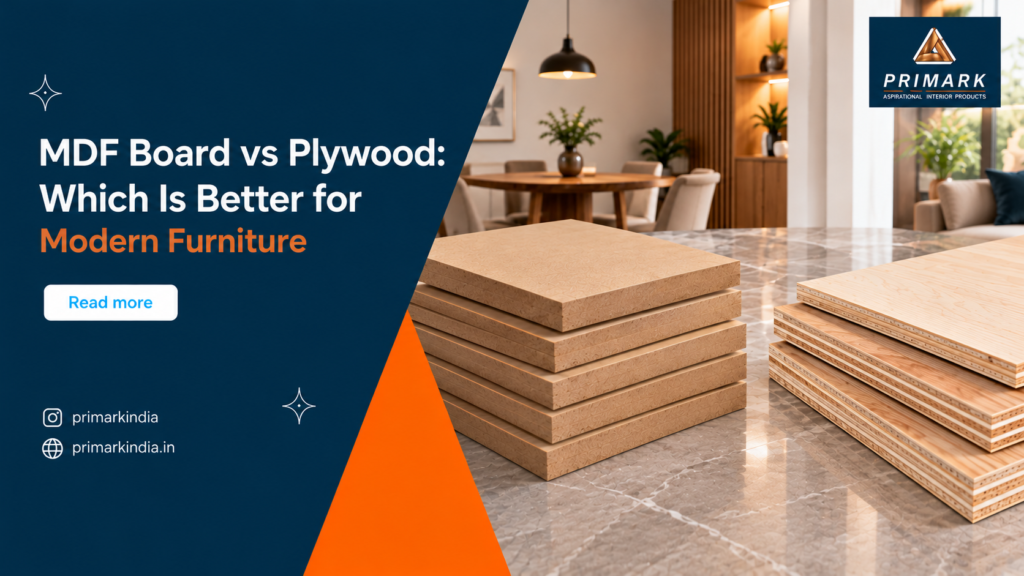
Choosing the right board matters a lot in today’s furniture making. The material changes the look, the lifespan, how simple it is to wipe down, and the total cost. It is important whether you are planning a modular kitchen, putting in a wardrobe, fitting a TV cabinet, or ordering custom pieces for a bedroom.
People often compare MDF boards with plywood sheets. They both work, but they do not work the same way. The best choice depends on where the item will be placed, how often it will be used day to day, and the kind of surface finish you want.
Which one should you choose, MDF or plywood, for modern furniture? This guide from Primark India lists the main differences and the points to check before you buy.
What Is an MDF Board?
MDF stands for Medium-Density Fibreboard. It is an engineered wood product made by combining fine wood fibres with resin and pressing them under heat and pressure to create a smooth, uniform board.
MDF boards are popular in modern interiors because their even surface makes them suitable for painted finishes, decorative laminates, and detailed designs.
Key Benefits of MDF Boards
- Smooth finish: Ideal for painted furniture and decorative surfaces.
- Design flexibility: Suitable for decorative panels, cabinet shutters, and intricate designs.
- Consistent surface: Has no natural wood grain, making finishing easier.
- Budget-friendly option: Can be economical for selected indoor furniture applications.
- Easy surface customisation: Works well with paints, laminates, and other compatible finishes.
Where Can You Use MDF Boards?
MDF boards are commonly used for:
- Wardrobe shutters and decorative cabinet fronts.
- TV units and entertainment cabinets.
- Study tables and bookshelves.
- Decorative wall panels and interior features.
- Indoor furniture that requires a smooth, uniform finish.
However, standard MDF can swell when exposed to moisture for extended periods. It is also generally less suitable than good-quality plywood for applications involving heavy loads or demanding structural requirements.
What Is Plywood?
Plywood is an engineered wood panel made by bonding thin layers of wood veneer together. The grain direction of adjacent layers is generally arranged at right angles, helping improve strength and dimensional stability.
High-quality plywood sheets are widely used in residential and commercial interiors because they offer a practical combination of strength, versatility, and durability.
Key Benefits of Plywood Sheets
- Good strength: Suitable for many furniture structures and load-bearing applications.
- Layered construction: Helps provide dimensional stability.
- Versatile applications: Can be used for cabinets, beds, shelves, and other furniture.
- Multiple grades: Available in different grades and specifications for different needs.
- Moisture-resistant options: Certain grades are designed for environments with greater moisture exposure, although no plywood should be assumed completely waterproof.
Where Can You Use Plywood?
Plywood is commonly used for:
- Modular kitchen cabinets and carcasses.
- Wardrobes and storage units.
- Beds, tables, and furniture frames.
- Shelving and cabinets that require strength.
- Office furniture and commercial interiors.
The performance of plywood depends on its grade, thickness, adhesive quality, manufacturing standards, and intended application.
MDF Board vs Plywood: Key Differences
Although both materials are used in modern furniture, they differ in construction, appearance, strength, and suitability for specific applications.
| Feature | MDF Board | Plywood |
| Material | Compressed wood fibres | Layers of wood veneer |
| Surface | Smooth and uniform | May show natural wood characteristics |
| Strength | Suitable for many indoor furniture applications | Generally preferred for stronger furniture structures |
| Decorative finishes | Excellent for paint and laminates | Suitable for laminates, veneers, and other finishes |
| Moisture resistance | Standard MDF is vulnerable to swelling | Depends on grade and adhesive; suitable grades may perform better |
| Detailed designs | Excellent for routed and decorative designs | Suitable for many designs, depending on construction |
| Typical applications | Cabinet fronts, panels, decorative furniture | Cabinets, beds, shelves, and furniture structures |
The main difference: MDF is often preferred for smooth finishes and decorative details, while plywood is generally a stronger choice for furniture structures that need to handle greater loads.
Which Is Better for Modern Furniture?
There is no single answer for every furniture project. The best material depends on the purpose of the furniture, the surrounding environment, and your budget.
1. For Modular Kitchen Furniture
Plywood is generally a practical choice for kitchen cabinet structures because of its strength and the availability of moisture-resistant grades.
For cabinet shutters and decorative elements, MDF may be suitable when a smooth painted finish is required. However, areas exposed to water, steam, or repeated moisture need careful material selection and proper edge sealing.
Our recommendation: Consider suitable-grade plywood for cabinet structures and MDF for selected decorative components, depending on the kitchen design.
2. For Wardrobes and Bedroom Furniture
Both materials can work well for wardrobes. MDF is useful for smooth, painted shutters and decorative designs, while plywood is often preferred for the main structure.
The final decision should consider the wardrobe’s dimensions, shelf loads, finish, and expected usage.
Our recommendation: Choose the material according to the function of each component rather than using one material for every part.
3. For TV Units and Decorative Wall Panels
MDF boards are a strong option for decorative furniture that requires a clean, uniform surface. They are especially useful for painted finishes, grooves, and customised designs.
Plywood can also be used where additional structural support is needed.
Our recommendation: Consider MDF for decorative elements and plywood for components that require greater strength.
4. For Beds, Tables, and Heavy-Duty Furniture
Plywood is generally better suited to furniture structures that experience repeated use or carry substantial loads. Proper thickness, support, joinery, and hardware remain essential.
MDF may be appropriate for selected non-structural panels, but it should not automatically replace plywood in high-stress applications.
Our recommendation: Prioritise suitable-grade plywood for structural components and use MDF where its smooth finish offers a clear design advantage.
MDF vs Plywood: Which Is More Cost-Effective?
The cost of MDF and plywood varies according to thickness, grade, quality, brand, and finish. The cheapest board is not necessarily the most economical choice over the life of your furniture.
MDF can offer value for decorative applications and painted surfaces. Plywood may justify its higher initial cost in furniture that requires additional strength or more demanding performance.
Before purchasing, compare:
- Board thickness and dimensions.
- Material grade and intended application.
- Moisture resistance and edge-sealing requirements.
- Surface finish and laminate compatibility.
- Installation, hardware, and maintenance costs.
For the best results, consider the total project cost rather than comparing the price of individual boards alone.
How to Choose the Right Board for Your Project
Before finalising your furniture material, keep these practical points in mind.
Consider Your Furniture Requirements
Ask yourself whether the board will be used for a structural cabinet, a decorative shutter, a shelf, or a wall panel. Each application has different performance requirements.
Check the Board Quality
Inspect the board’s surface, thickness, edges, and overall condition. For plywood, ask about the grade and intended use. For MDF, confirm whether the product is suitable for the expected environment.
Choose the Right Finish
Painted furniture and intricate decorative designs often benefit from MDF’s smooth surface. Plywood is versatile enough for laminates, veneers, and many other finishes.
Buy from a Reliable Supplier
Working with experienced suppliers makes it easier to compare material specifications and select the right product. If you are searching for MDF board suppliers in Jaipur, look for a supplier who can explain the available grades, applications, and finish options clearly.
You can also compare plywood sheets in Jaipur by checking their specifications and suitability for your furniture requirements.
Why Choose Primark India for Interior Panel Solutions?
Primark India helps customers explore materials and solutions for contemporary interiors. Whether you are planning a home renovation, upgrading office furniture, or designing a new living space, selecting the right board is an important first step.
When visiting an Interior Panel Showroom, consider the complete range of materials available for your project, including MDF boards, plywood sheets, and decorative panel options.
A dependable source for interior materials should help you understand product specifications, compare suitable alternatives, and make an informed purchasing decision.
Before placing an order, discuss your furniture design, installation area, preferred finish, and budget. This makes it easier to select materials that balance appearance, practicality, and long-term value.
Conclusion: MDF Board or Plywood?
MDF boards and plywood sheets both show up in today’s furniture builds. MDF works well when you want a flat, smooth face. It is often chosen for painted parts, shutters, and small decorative pieces. Plywood is usually picked when the piece must carry load. Many structural parts need firm, steady support.
In a lot of indoor projects, using both materials can make sense. Still, the main step is to match each material to the task. Do not treat one option as the best choice for everything.
Planning furniture for a home or workplace? Check the interior panel choices from Primark India. Look at MDF boards and plywood options, then select what fits your design, your budget, and how the unit will be used. boards and plywood options to find the right fit for your design, budget, and functional needs.
Frequently Asked Questions (FAQs)
1. Which is better for modern furniture, MDF or plywood?
MDF is ideal for smooth finishes and decorative designs, while plywood is generally better for stronger furniture structures. The best option depends on the application.
2. Are MDF boards suitable for wardrobes?
Yes, MDF boards are suitable for many wardrobe shutters and decorative components, especially when a smooth painted finish is desired.
3. Is plywood better than MDF for modular kitchens?
Plywood that is the right grade is usually the better pick for building kitchen cabinet boxes.
MDF can work for some cabinet doors, but only if you keep water exposure under control.
4. Can MDF boards be used for TV units?
MDF boards are often chosen for TV units. They also fit well for decorative wall panels. Many people use them in entertainment cabinets too. The main reason is that the surface stays smooth and even.
5. Are plywood sheets more durable than MDF boards?
Plywood is generally stronger for structural applications, while MDF performs well in suitable indoor decorative applications. Durability depends on product quality and usage.