
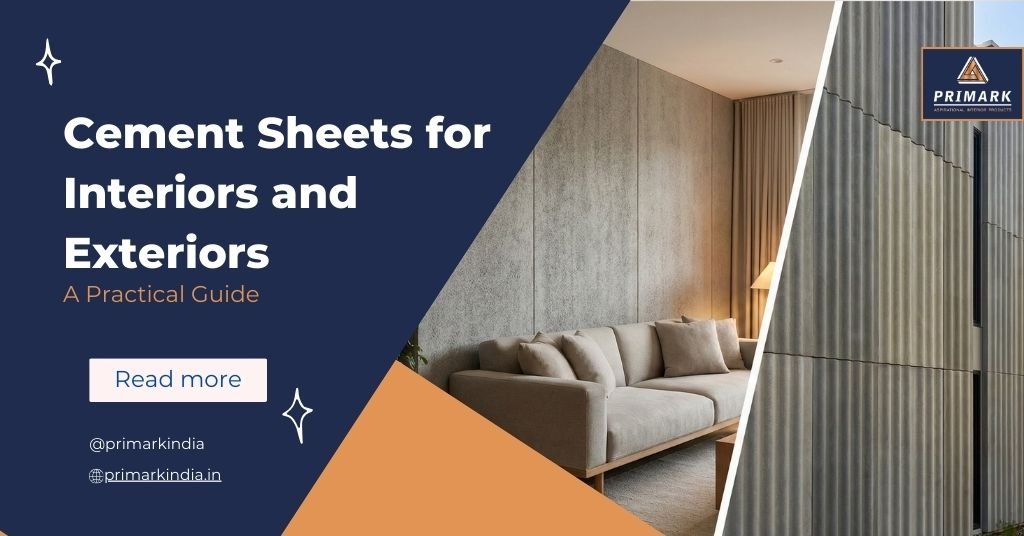
If there’s one material that people often underestimate in interior and exterior design, it’s cement sheets. Over the years, I’ve seen cement sheets quietly solve problems where plywood, MDF, or PVC boards completely fail — especially in moisture-heavy or high-impact areas.
Most homeowners think cement sheets are only meant for construction or industrial use. In reality, cement sheets have become one of the most reliable boards and panels for modern interiors and exteriors, when used correctly.
This guide is based on real-world use, not brochures. I’ll explain where cement sheets work best, where they don’t, and how to use them smartly so you get durability without compromising design.
What Are Cement Sheets?
Cement sheets are rigid boards made from cement, fibres, and reinforcing materials. They are designed to be strong, moisture-resistant, fire-resistant, and stable in extreme conditions.
In interior and exterior projects, cement sheets are commonly used as:
- Wall backing boards
- Exterior cladding base
- Partition walls
- Ceiling boards
- Wet-area wall panels
They are part of a growing category of panel boards used for long-term durability, especially in Indian climates.
Why Cement Sheets Are Different From Other Boards
Having worked with plywood boards, PVC boards, MDF, and particle board, the difference becomes very clear over time.
Cement sheets:
- Do not swell with moisture
- Do not attract termites
- Do not bend or warp
- Handle heat and rain well
- Offer long lifespan
This makes them ideal where traditional wood-based boards struggle.
Where Cement Sheets Work Best (From Experience)
Cement Sheets for Exterior Walls
One of the strongest use cases for cement sheets is exterior wall applications.
They are widely used as a base for:
- Exterior wall cladding
- Stone veneers
- PU stone
- Outdoor decorative panels
Because cement sheets can handle rain, sunlight, and temperature changes, they create a stable surface for decorative exterior finishes.
Reality check:
Using plywood or MDF outdoors is a guaranteed failure. Cement sheets are the correct solution here.
Cement Sheets for Interior Wet Areas
Bathrooms, wash areas, and utility spaces are where most boards fail.
Cement sheets are ideal for:
- Bathroom wall backing
- Utility room walls
- Wash basin areas
- Areas behind tiles or stone finishes
Unlike MDF or particle board, cement sheets don’t swell or crumble when exposed to moisture.
Cement Sheets for Partitions and Paneling
Cement sheets are increasingly used for:
- Office partitions
- Commercial interiors
- Industrial-style homes
They provide strength and fire resistance, especially where boards and panels need to perform long-term.
Cement Sheets vs Plywood Boards vs PVC Boards
This comparison is something clients ask all the time.
Cement Sheets vs Plywood Boards
- Plywood is better for furniture
- Cement sheets are better for walls and wet areas
- Plywood looks warmer; cement sheets are structural
Cement Sheets vs PVC Boards
- PVC boards are lighter and easier to install
- Cement sheets are stronger and more durable
- PVC works well in modular interiors; cement sheets work better for long-term structural use
Each material has a role — the mistake is using one everywhere.
Can Cement Sheets Be Used for Interior Design?
Yes — and this is where modern design comes in.
Cement sheets are often used as a base board, on top of which designers install:
- Stone veneers
- PU stone
- Decorative boards
- Textured wall finishes
They are rarely the final visible surface but act as a strong foundation for premium finishes.
Installation Reality: What Most People Don’t Know
Cement sheets require:
- Proper framing or wall support
- Correct screws and spacing
- Skilled installation
If installed poorly, even cement sheets can crack at joints. However, once installed correctly, they outlast most other panel boards.
Important tip:
Never install cement sheets like plywood. They follow a different installation method.
Maintenance and Lifespan
One of the biggest advantages of cement sheets is low maintenance.
- No termite treatment needed
- No water damage
- Minimal cracking if installed correctly
In long-term projects, cement sheets often last 15–20 years without replacement.
Common Mistakes I See With Cement Sheets
- Using them for furniture (not recommended)
- Installing without proper support
- Skipping expansion gaps
- Using poor quality fasteners
Cement sheets are strong — but they still need correct handling.
Final Thoughts From Experience
Cement sheets are not a replacement for plywood or MDF — they are a solution for specific problems. When used in the right places, they outperform most boards and panels in durability and stability.
If your project involves moisture, exterior exposure, or heavy wall finishes, cement sheets are not optional — they are essential.
Smart interiors are not about fancy materials everywhere, but about using the right material in the right place.
Ready to Upgrade Your Interiors?
Discover cement sheets, stone veneers, and durable wall solutions at Primark India.
Phone: +91-7340018900
Website: https://primarkindia.in/
FAQs: Cement Sheets for Interiors and Exteriors
Q1. Are cement sheets waterproof?
Cement sheets are moisture-resistant and do not swell, making them suitable for wet areas.
Q2. Can cement sheets be used indoors?
Yes, especially for wall backing, partitions, and wet areas.
Q3. Are cement sheets better than plywood for exteriors?
Yes, plywood should never be used outdoors. Cement sheets are far more durable.
Q4. Can cement sheets hold stone veneers?
Yes, cement sheets are an excellent base for stone veneers and PU stone.
Q5. Do cement sheets crack over time?
Only if installed incorrectly. Proper installation prevents cracking.